The Janka Wood Hardness Scale refers to a range of numbers that determine the density of the wood.
When looking into what wood materials you would like to use in your projects, the hardness and durability of the wood is very important to note. You may be wondering, “How can I find out the hardness of a wood material? And what does that mean?”
Well, have no fear, because we are here to tell you a little bit about the Janka Wood Hardness Scale.
What is the Janka Hardness Scale?
The Janka Wood Hardness Scale refers to a range of numbers that determine how dense a type of wood is and how resistant to dents, dings, and wear that a type of wood will be once installed.
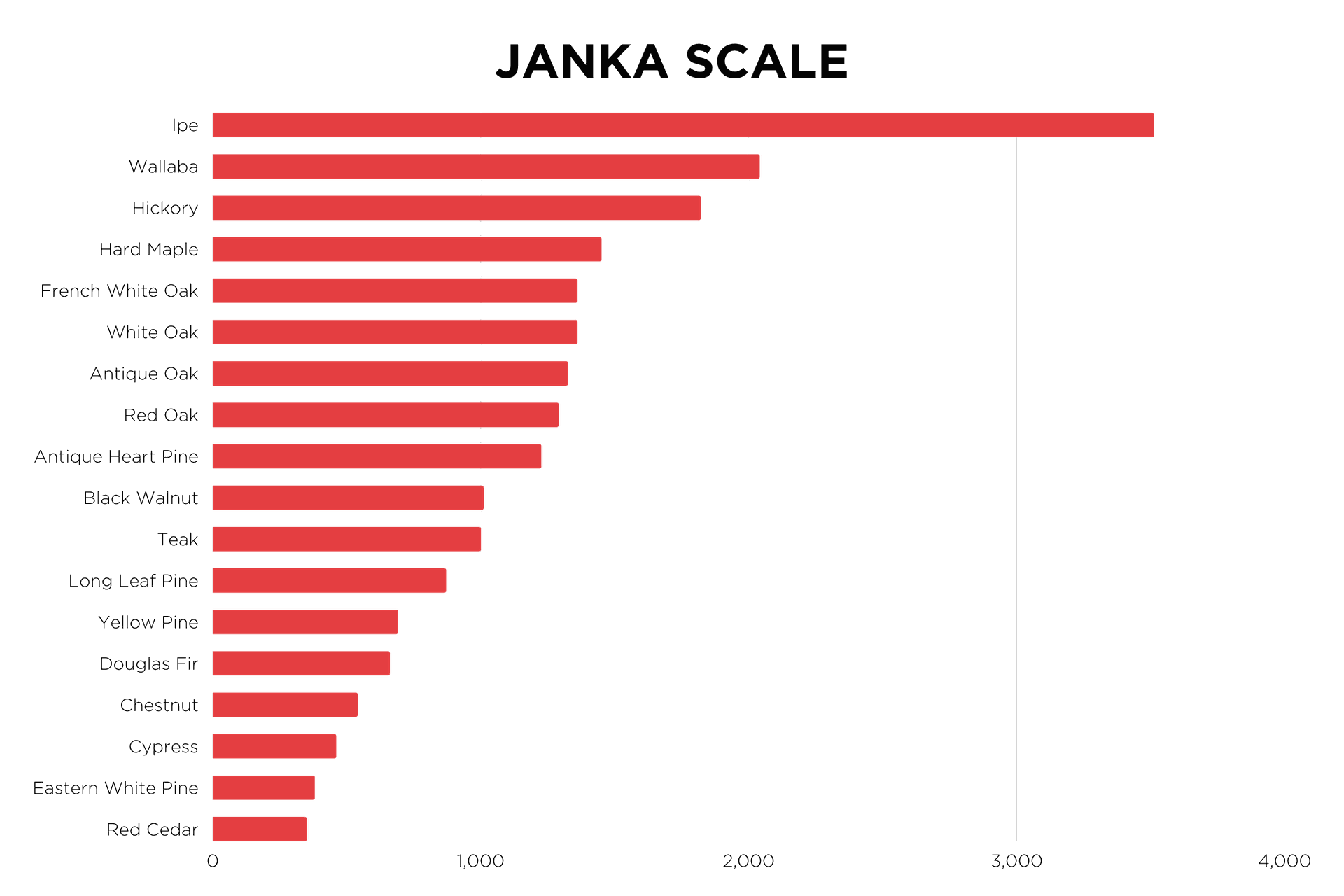
Extremely Hard
Ipe - 3510
Wallaba - 2040
Hickory - 1820
Hard Maple - 1450
French White Oak - 1360
Hard
American White Oak - 1360
Antique Oak - 1325
Red Oak - 1290
Antique Heart Pine - 1225
Black Walnut - 1010
Medium
Teak - 1000
Long Leaf Pine - 870
Yellow Pine - 690
Douglass Fir - 660
Chestnut - 540
Soft
Cypress - 460
Eastern White Pine - 380
Red Cedar - 350
Janka Hardness Ratings: A Guide
Wood Species | Janka Rating (lbf) | Durability Level | Best Use |
3510 | Extremely Hard | Commercial / high-traffic | |
Wallaba | 2040 | Extremely Hard | Commercial / heavy-use |
1820 | Very Hard | High-traffic residential | |
Hard Maple | 1450 | Hard | Residential |
French White Oak | 1360 | Hard | Residential |
1360 | Hard | Residential | |
Antique Oak | 1325 | Hard | Residential |
1290 | Hard | Residential | |
Antique Heart Pine | 1225 | Medium-Hard | Residential |
1010 | Medium | Lower-traffic residential | |
Teak | 1000 | Medium | Residential |
870 | Softer Wood | Lower-traffic areas | |
Yellow Pine | 690 | Softer Wood | Light residential use |
Douglas Fir | 660 | Softer Wood | Light residential use |
Chestnut | 540 | Soft Wood | Decorative / lower-traffic |
Cypress | 460 | Soft Wood | Decorative applications |
Eastern White Pine | 380 | Soft Wood | Decorative applications |
Red Cedar | 350 | Soft Wood | Decorative applications |
What do these numbers mean?
The Janka wood hardness rating scale is determined by the Janka hardness test. The Janka hardness test measures the resistance of a sample of wood to denting and wear. It measures the force required to embed an 11.28 millimeters (0.444 in) diameter steel ball halfway into a sample of wood. This method leaves a hemispherical indentation with an area of 100 mm2. (Wikipedia, n.d.)
With the Janka wood hardness scale in mind, the higher the number, the more resistant the wood is to denting and wear.
For reference, when comparing two types of wood like Hickory and Chestnut, Hickory has a Janka wood hardness rating of 1820 while Chestnut has a rating of 540. From this comparison, Hickory is the more resistant wood.
The Janka rating is also a good indication of how hard the wood will be to saw or nail.

Which wood should you choose?
Depending on what you are looking to use the materials for, each kind of wood has its own unique qualities.
The Janka Wood Hardness Scale has become an industry guide for determining whether a wood species is suitable for flooring. Red Oak has a Janka hardness rating of 1290, and this species has become a benchmark for comparing different wood species and their relative hardness.
If you are looking to install wood flooring in a high-traffic area such as a commercial space, then something with a higher Janka rating, like White Oak or European Oak, may be a better fit. Choosing a higher-rated wood can help reduce the visible effects of dents and wear over time.
If you are selecting flooring for a lower-traffic area, such as a bedroom, a softer species like Walnut may still perform well while offering a different visual character.
All wood will eventually show wear over time, regardless of its Janka rating. The scale should be viewed as one factor within the broader decision-making process, alongside finish, maintenance, environment, and how the space will be used.
Using the Janka Scale as a guide
While every project is different, the following ranges can serve as a useful reference point when comparing wood species for flooring applications:
- Under 1,000 → Better suited to lower-traffic areas such as bedrooms or decorative spaces
- 1,000–1,500 → Commonly used across standard residential flooring applications
- 1,500+ → Better suited to high-traffic homes and busier residential environments
- 2,000+ → Often selected for demanding commercial or heavy-use applications
All wood will eventually show wear over time, regardless of its Janka rating. The scale should be viewed as one factor within the broader decision-making process, alongside finish, maintenance, environment, and how the space will be used.
How does the Janka Scale apply to Reclaimed Wood?
Reclaimed wood can still be evaluated using the Janka scale, but hardness ratings should be considered alongside the history and character of the material itself.
Species such as Reclaimed Oak and Reclaimed Long Leaf Pine remain popular flooring choices due to their durability, aging characteristics, and distinctive grain patterns developed over time.
Because reclaimed flooring is sourced from previously used material, factors such as age, original application, and long-term drying can all influence how the wood behaves once installed. While hardness remains an important consideration, reclaimed wood is often selected just as much for its texture, patina, and material character.
As with any flooring selection, the Janka rating should be viewed alongside finish, maintenance, environment, and how the space will be used day to day.
Choosing the right wood for your project
Understanding the Janka Wood Hardness Scale can help guide your selection, particularly when comparing how different wood species may perform over time.
While hardness is an important consideration, it should always be viewed alongside the broader context of the project – including finish, environment, maintenance, and the way the space will be used day to day.
At WoodCo, we work with a wide range of wood species across residential and commercial applications, helping clients select flooring that balances durability, performance, and material character.
If you’re planning a project and would like guidance on selecting the right wood flooring, explore our engineered wood flooring collections or get in touch with our team.
Janka Hardness Scale: Frequently Asked Questions
What is a good Janka rating for flooring?
For most residential flooring applications, wood species with a Janka rating between 1,000 and 1,500 offer a strong balance between durability and everyday practicality. Higher ratings are often preferred in busier homes or heavier-use environments where dent resistance is a priority.
Is a higher Janka rating always better?
Not necessarily. While harder wood species are generally more resistant to dents and wear, hardness is only one part of flooring performance. Finish, maintenance, environment, and how the space is used all play an important role.
Is engineered wood measured by the Janka scale?
The Janka rating applies to the wood species itself. Because engineered wood flooring uses a real wood surface layer, species such as White Oak, Walnut, or Hickory will still carry the same relative hardness characteristics.
What is the hardest wood in the world?
One of the hardest commercially used wood species is Ipe (often referred to as Brazilian Walnut), with a Janka hardness rating of approximately 3510 lbf.