We're all familiar with the patterns of classic wood grain, whether it's the visible growth rings on an end-cut piece or the sweeping lines of a plank cut perpendicular to the trunk.
But what creates these patterns? When you look at a piece of wood flooring, you're seeing a record of how a tree grew: the conditions it experienced, the rate at which it developed, and the structure it built over decades. That biology has a direct bearing on how a floor looks, how it performs, and how it ages.
From grain pattern and color variation to hardness and dimensional stability, the anatomy of a tree shapes every material decision that follows. Understanding wood structure is the foundation of good material selection, and it's where every conversation about custom wood flooring begins.
What's Inside a Tree?
It's a common misconception that tree trunks are simply made up of two layers: the outer bark and the inner wood. Beneath the bark there are several distinct layers, each with its own function, and each contributing something to the character of the wood that comes from it.

If we cut a cross-section of a mature tree’s trunk, we’ll see many different layers, arranged in concentric rings. These are named as follows:
1. The Outer Bark
The tree's protective layer, shielding it from weather, pests, and disease. Bark is made up of dead cells from the layer beneath, constantly dividing and replenishing to allow for the tree's growth. It plays no role in the finished floor (it's removed during milling) but its thickness and texture vary widely by species: rough and furrowed in pine, relatively smooth in oak.
2. The Phloem
A thin, soft layer just beneath the bark, packed with vessels responsible for transporting sugars generated during photosynthesis down from the leaves to the roots. Like bark, the phloem is removed during milling and doesn't appear in finished flooring.
3. The Cambium
The cambium is the growth engine of the tree – a thin layer of actively dividing cells where all new growth originates. It grows both inward and outward: adding new phloem cells on the outer side, and new layers of wood, called xylem, on the inner side. This is what produces the growth rings visible in every cross-section of a trunk.
The cambium also produces cells that form medullary rays. These structures extend outward from the center of the tree like spokes, transporting stored nutrients laterally. In harvested wood, these rays become one of the most distinctive visual features: the silver-grey fleck pattern that defines quarter and rift sawn oak is made up of medullary rays exposed by the angle of the cut.
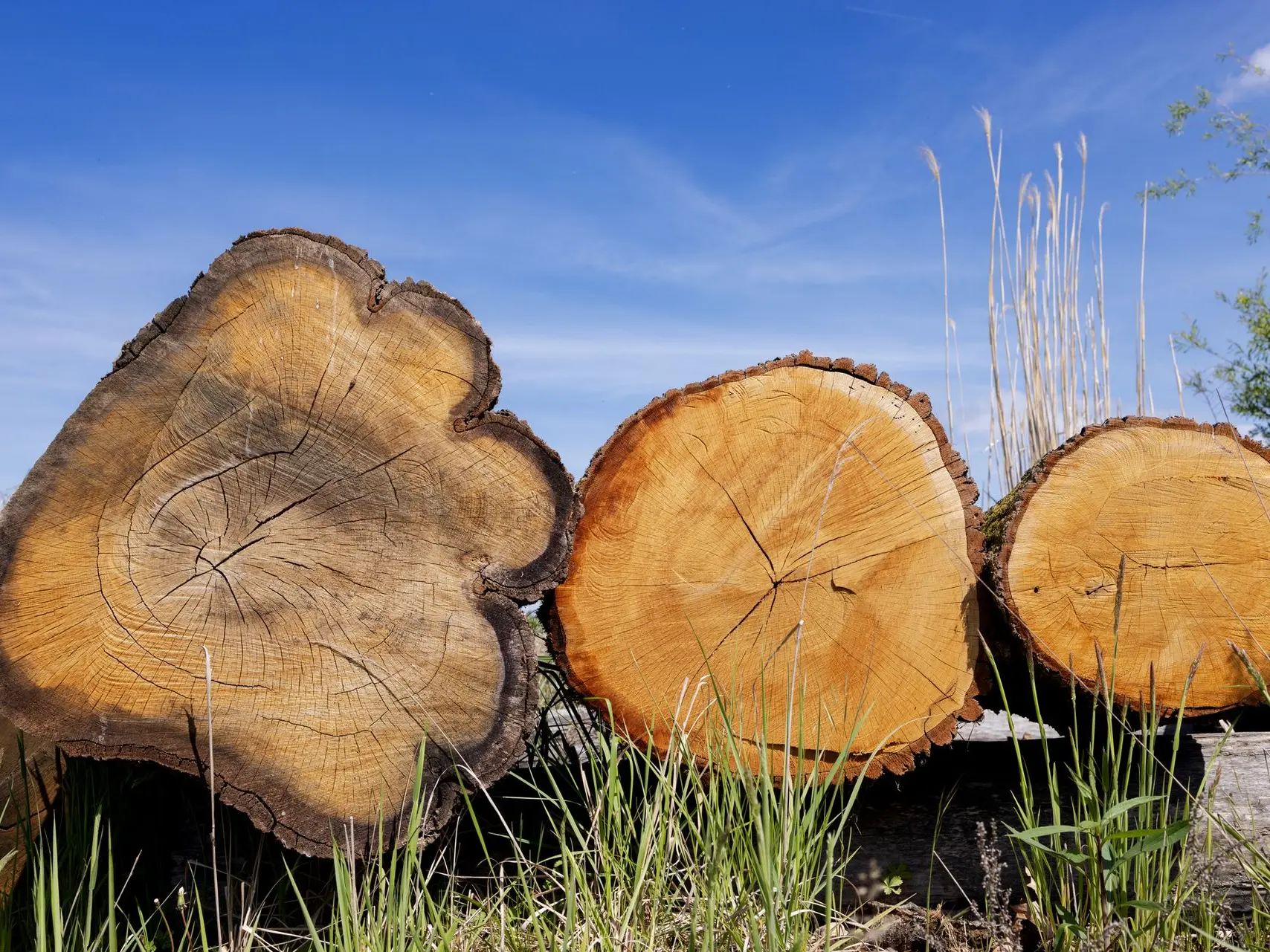
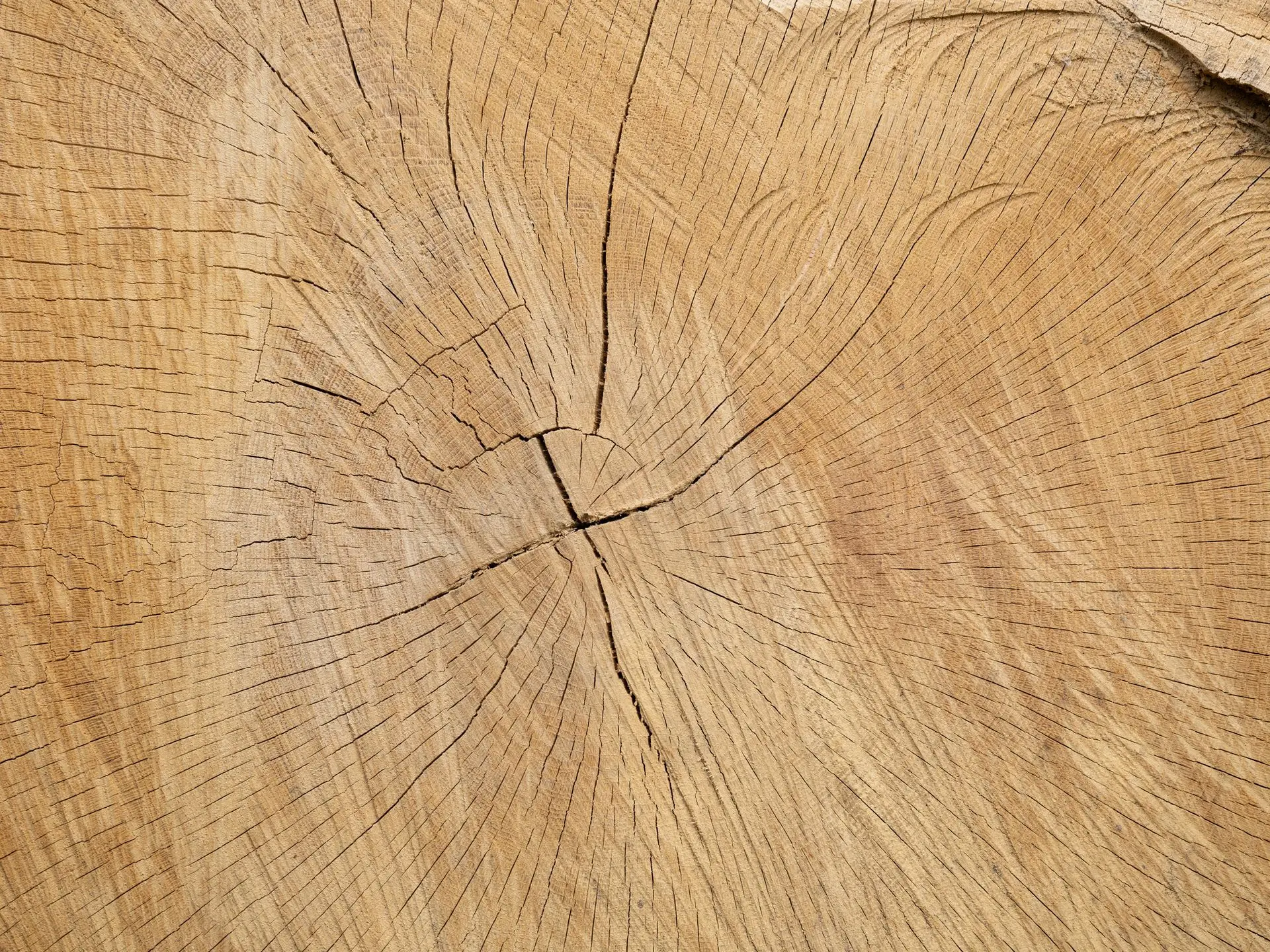
End grain clearly showing medullary rays
4. The Xylem / Sapwood
The sapwood – the youngest wood layer of the tree – is created each year by the cambium. In spring and summer, it forms quickly and has a lighter color; in winter, growth slows or stops entirely. This seasonal variation is what creates the growth rings. Wide rings indicate fast growth in favorable conditions; narrow rings reflect slower growth, often due to environmental stress.
Sapwood is lighter in color and less dense than heartwood, and tends to show more color variation between boards. This is worth factoring into material selection where consistency across a floor matters.
5. The Heartwood
The heartwood is the structural core of the tree: older, non-living xylem that has solidified into dense, durable wood. Its primary role is to give the trunk strength and stability as the tree grows taller. It also stores naturally occurring sugars, dyes, and oils that give many species their distinctive color.
Heartwood is typically harder, more stable, and richer in color than sapwood, which is why it's the preferred material for premium flooring. The depth of color in American black walnut, the warmth of white oak, the reddish tones of red oak – all of these are heartwood characteristics.
6. The Medulla / Pith
The central core of the tree, representing its earliest growth. It has a soft, porous structure and was vital to nutrient storage and transportation when the tree was young. In older trees, the medulla is often replaced by xylem or dries out, leaving a hollow centre. It's avoided during milling and doesn't appear in quality finished flooring.
From Tree to Floor: A Quick Reference
The table below summarizes each layer and its relevance to the finished floor.
Tree layer | Natural function | From tree to floor |
Bark | Protection | Removed during milling |
Phloem | Nutrient transport | Removed during milling |
Cambium | Growth layer | Produces the growth rings visible in every plank. Ring width reflects how fast the tree grew, which affects grain density and character. |
Sapwood | Active water transport | The younger, lighter-colored wood. Less dense and more variable between boards, which can affect color consistency across a floor. |
Heartwood | Structural core | The mature core of the tree. Denser, harder, and richer in color than sapwood; the part of the tree most valued for premium flooring. |
Medullary rays | Lateral nutrient transport | Revealed as a silver or light-toned fleck across the face of quarter and rift sawn boards. The defining visual characteristic of quarter sawn oak. |
How Do Tree Structures Show Up in Wood Grain?
A cross-section of a trunk shows all of a tree's layers clearly: the concentric growth rings, the medullary rays extending outward from the center, the distinction between sapwood and heartwood. But since floors are rarely made from end-grain wood, these structures look quite different depending on how the log is cut.
The cut method is one of the most consequential decisions in flooring specification. It determines grain character, visual consistency, dimensional stability, and how a floor will move with seasonal humidity changes. Here's what each method produces.
Plain Sawn (also called Flat Sawn)

The most common and efficient cut: the log is sawn lengthways, roughly parallel to the growth rings. This produces the classic arching or cathedral grain pattern – wider boards show a more dramatic sweep; narrower boards show a tighter version of the same pattern.
Plain sawn is the most cost-effective method because it yields the most usable material from each log. It also produces the widest boards. The trade-off is that plain sawn wood is more susceptible to cupping and movement with changes in moisture and humidity, because the growth rings are oriented horizontally across the face of the board, which is the direction in which wood moves most.
For interiors with stable humidity conditions, plain sawn works well and gives a traditional, characterful result. For projects with underfloor heating, significant humidity variation, or a requirement for very wide boards, it's worth considering the alternatives.
Quarter Sawn

The log is cut into quarters first, then each quarter is sawn so the growth rings meet the face of the board at roughly 60–90 degrees. This produces a tight, linear grain notably different from the arching pattern of plain sawn. Depending on species, can reveal the medullary rays as a distinctive silver or light-toned fleck across the face of the board.
In oak, this fleck effect is particularly pronounced and has been prized in furniture and architectural joinery for centuries. In an engineered floor, it reads as a refined, consistent surface with real depth.
Beyond aesthetics, quarter sawn wood is significantly more dimensionally stable than plain sawn. The vertical orientation of the growth rings means the board moves less across its width with humidity changes, making it a strong specification choice for projects with underfloor heating, or anywhere long-term stability is a priority. It's also more resistant to surface wear, as the harder growth rings are oriented vertically through the face of the board.
The limitation is yield: quarter sawing produces narrower boards and more waste, which makes it more expensive to produce. It's part of what goes into how a WoodCo floor is made, every cut method involves trade-offs between character, stability, and yield.
See our engineered flooring collection for options combining the stability of engineered construction with the visual quality of quarter sawn faces.
Rift Sawn

Rift sawn boards are cut at around 45 degrees to the growth rings, between the angles of plain and quarter sawn. This produces a consistent, straight grain with minimal ray fleck: a clean, linear surface without the arching of plain sawn or the pronounced fleck of quarter sawn.
Rift sawn is often used when uniformity across a floor is the primary goal. The grain pattern is the most consistent of any cut method, which makes it particularly well-suited to contemporary interiors where the floor needs to read as a quiet, even surface rather than a characterful one.
Like quarter sawn, rift sawn wood is more stable than plain sawn. Boards are typically narrower, since rift cuts come from the sections of the log left after quarter sawn boards have been milled, which again affects cost and yield.
Live Sawn

Live sawn (sometimes called through-and-through or French sawn) involves cutting the log in a series of parallel passes straight through the centre of the trunk. The result is wide boards that show the full range of the tree's grain in a single plank: cathedral pattern at the centre, transitioning to straighter grain with ray fleck toward the edges, and sometimes including the sapwood band for a more varied, natural appearance.
Live sawn is the method that most faithfully represents the full character of the tree. No part of the log is wasted in pursuit of a specific grain pattern, which makes it the most efficient cut after plain sawn and allows for extra-wide boards.
It's a strong choice for interiors where material character and individuality matter – a live sawn white oak floor reads very differently from a quarter sawn one, with more visual movement and a less uniform, more organic quality. Stability is intermediate: better than plain sawn, not as stable as quarter or rift sawn.
How Does Tree Species Influence Structure and Grain?
Species determines the underlying character of the wood, including its density, ring structure, color, and how each of those characteristics responds to cutting and finishing. Fast-growing species have wider growth rings and more dramatic grain patterns; slow-growing species tend to be denser, with tighter rings and more subtle figures.
Oak
Oak is slow-growing and reaches maturity over many decades. The result is tight, prominent growth rings and well-developed medullary rays, which is why oak responds so distinctively to quarter and rift sawing. Red oak has a warm, reddish tone with an open grain; white oak is slightly harder, more neutral in color, and has a finer, tighter grain that finishes exceptionally well. White oak is also naturally more resistant to moisture, which makes it a practical choice as well as an aesthetic one.
Pine
Pine is a fast-growing softwood with wide growth rings, a higher proportion of sapwood, and prominent knots where branches connect to the main trunk. Floors are most often plain sawn to maximize yield from slender trunks, producing that classic cathedral grain pattern. Pine has a lower Janka hardness rating than oak or walnut, which affects its suitability for high-traffic areas, though for the right project, its character and warmth are hard to replicate.
Walnut
One of the densest American hardwoods, walnut grows slowly and develops a rich, dark heartwood with a naturally fine, straight grain that’s occasionally broken by wavy or curly figures that adds visual complexity. The contrast between walnut's dark heartwood and its creamy sapwood can be dramatic, which is worth specifying carefully depending on the intended aesthetic. Walnut's density makes it exceptionally durable and gives it a Janka hardness that outperforms many species used in residential flooring.

FAQ
What is heartwood vs sapwood?
Heartwood is the dense, non-living core of the tree – the part that gives the trunk its structural strength. Sapwood is the younger, outer wood layer, still active in transporting water from the roots. In flooring, heartwood is typically harder, darker, and more stable. Sapwood is lighter in color and more variable between boards. Not inferior, but different, and this is reflected in grading.
Is heartwood stronger and more durable than sapwood?
Generally, yes. Heartwood is denser and contains natural oils, resins, and tannins that improve resistance to moisture and decay. Both can be used in quality flooring, but heartwood offers better consistency – in color, hardness, and long-term performance – which matters most when specifying across a large area.
Does cut method affect performance, not just appearance?
Yes. Quarter and rift sawn floors are more dimensionally stable than plain or live sawn, because the growth rings are oriented vertically through the face of the board. This reduces movement with seasonal humidity changes. An important consideration for projects with underfloor heating or significant climate variation between seasons.
Why do growth rings vary in width?
Ring width reflects growing conditions year by year. Wide rings indicate fast growth in favorable conditions; narrow rings reflect slower growth, often due to drought or environmental stress. In the finished floor, ring density affects grain character and how the wood responds to staining and finishing.
Does species affect dimensional stability?
Yes, and cut method compounds it. Denser, slow-growing species like white oak and walnut are more stable than fast-growing softwoods like pine. A quarter sawn white oak floor sits at one end of the stability spectrum; plain sawn pine at the other. For projects where stability is the priority, species and cut method should be considered together.
Custom wood floors
The next time you admire a wood floor, take a moment to appreciate the intricate biology behind its beauty - from the growth rings that record the passing years to the grain patterns shaped by the tree’s structure.
At WoodCo, we aim to celebrate and unlock the natural beauty of every piece of lumber we produce in our mill, so if you’ve got a specific look in mind, we’ll be happy to help you achieve it.